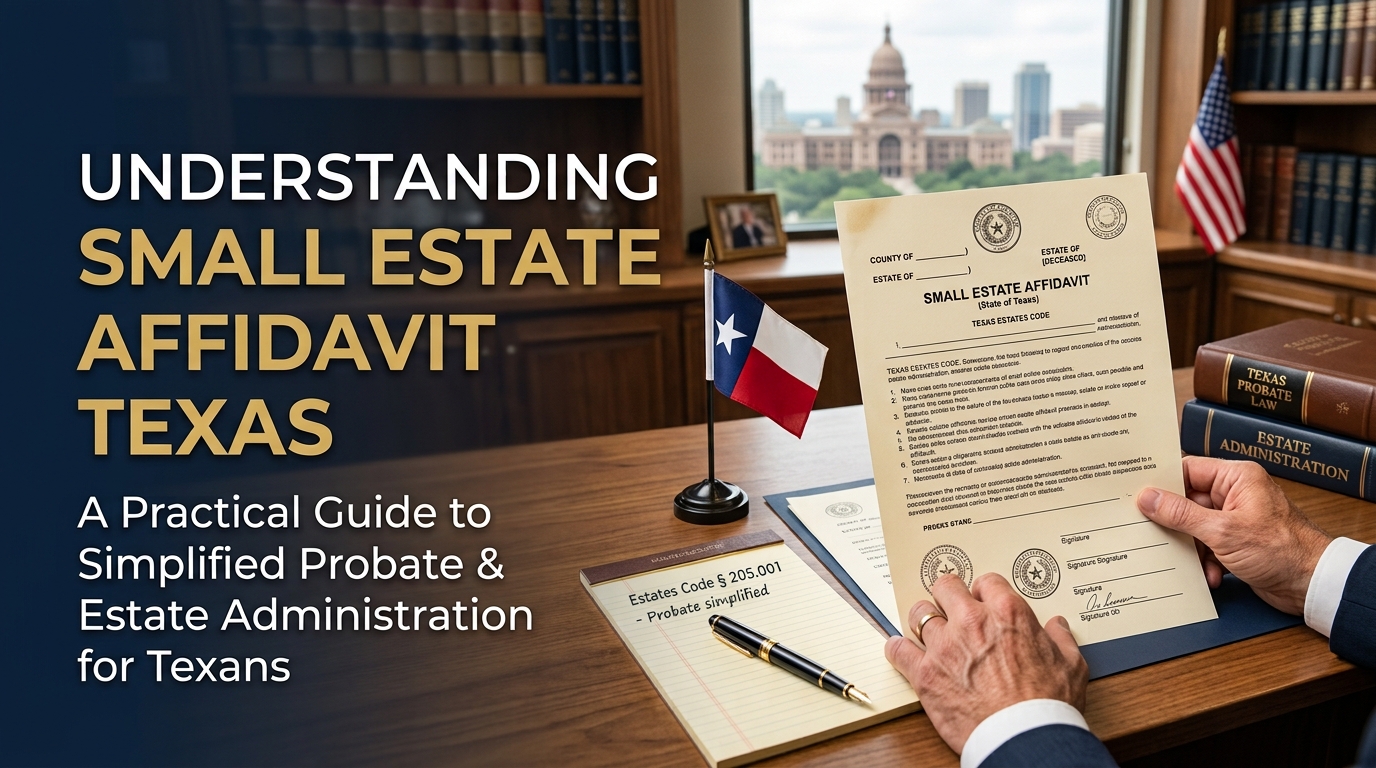
When someone dies in Texas without a will and without a large estate, their family doesn’t always need months of formal probate court proceedings. Texas offers a faster, cheaper alternative called a small estate affidavit (SEA). This guide covers the small estate affidavit Texas requirements, where to find the correct form, how filing works county by county, and how it stacks up against full probate, muniment of title, and letters testamentary.
Quick answer: A Texas small estate affidavit is available when someone dies without a will, at least 30 days have passed since death, the estate’s non-exempt, non-homestead assets are worth $75,000 or less, and the assets exceed the debts. It’s filed with — and must be approved by — the probate court in the county where the decedent lived.
What Is a Small Estate Affidavit in Texas?
A small estate affidavit is a sworn legal document, authorized under Texas Estates Code Chapter 205, that lets the heirs of someone who died without a will collect that person’s property without asking a court to formally appoint an executor or administrator. Instead of opening a full probate case, the heirs (called distributees) and two witnesses sign a detailed affidavit listing the decedent’s assets, debts, and family history. A judge reviews it, and once approved, certified copies of the affidavit become the legal authority that banks, title companies, and other institutions rely on to release the decedent’s property.
The state of Texas small estate affidavit process exists for exactly the situation many families face: a modest bank account, a car, maybe a small home, and no will to guide who gets what.
Small Estate Affidavit Texas Requirements
Texas Estates Code § 205.001 sets out specific conditions, and courts apply them strictly — an affidavit that misses even one requirement is routinely rejected. To use a small estate affidavit in Texas, all of the following generally must be true:
- No will. The decedent must have died intestate — without a valid will. If a will exists, a small estate affidavit cannot be used, whether or not that will has ever been filed for probate.
- 30-day waiting period. At least 30 days must have passed since the date of death before the affidavit can be filed.
- No pending administration. No one can have already filed for, or been granted, appointment as executor or administrator of the estate.
- $75,000 asset limit. The value of the estate’s non-exempt, non-homestead assets cannot exceed $75,000 as of the date of the affidavit. (The Texas Legislature raised this limit from $50,000; always confirm the current figure, since statutory limits can change.)
- Assets must exceed debts. The estate’s non-exempt, non-homestead assets must be worth more than its known liabilities (not counting any debt secured by the homestead).
- Real property limited to the homestead. The only real estate the decedent can have owned is their homestead. A small estate affidavit cannot transfer title to any other real property — a second home, rental property, or vacant land all require a different process.
- Proper signatures. Every distributee with legal capacity must sign, along with two “disinterested” witnesses — people who knew the family, aren’t owed money by the estate, and won’t inherit anything from it. If an heir is a minor or incapacitated, their guardian or next of kin signs on their behalf.
Even when every box is checked, approval isn’t automatic — judges have discretion to deny an affidavit, and filing fees are typically non-refundable when that happens. That’s why many families have an attorney review the affidavit before submitting it.
What Counts Toward the $75,000 Limit?
This is where a lot of filings go wrong. The cap only applies to certain property.
Counts toward the limit: bank accounts, vehicles, and most other ordinary probate assets.
Does not count toward the limit:
- The homestead (regardless of its value, subject to the homestead rules below)
- “Exempt” property under Texas Property Code § 42.002(a) — things like home furnishings, tools of a trade, and certain vehicles — up to $100,000 for a family or $50,000 for a single adult
- The decedent’s pension benefits, IRAs, and insurance proceeds
- Non-probate assets that transfer automatically outside of probate, such as life insurance or retirement accounts with a named beneficiary, payable-on-death accounts, and property held in joint tenancy with right of survivorship
The homestead deserves special attention. It can pass through the small estate affidavit process to a surviving spouse or minor children who lived there, regardless of the home’s value — but the completed, approved affidavit must then also be recorded in the real property (deed) records of the county where the home sits, not just filed with the probate court.
Small Estate Affidavit Form Texas: Where to Find It
Here’s something that surprises a lot of people: there is no single, universal state of Texas small estate affidavit form. Chapter 205 spells out what the affidavit must contain, but each county probate court is free to design and require its own version. A small estate affidavit Texas PDF pulled from one county’s website may get rejected by the clerk in a different county.
Before filling anything out, check the website of the probate court (or county court at law that handles probate matters) in the county where the decedent lived. Many counties — including Dallas, Tarrant, Travis, Montgomery, Cameron, and Fort Bend — publish their own required SEA form along with a local checklist. Using a generic template from a legal-forms website, or another county’s form, is one of the most common reasons affidavits get sent back for revision.
Harris County Small Estate Affidavit
For a small estate affidavit Texas Harris County filing, the fill-in-the-blank form is published by Harris County’s probate courts, and the completed affidavit is filed with the Harris County Clerk’s Office (Probate). Harris County has multiple statutory probate courts, so confirm which one has your case before filing. As in other counties, Harris County charges a filing fee, and while a hearing isn’t always required, the court can request one — or ask for additional documentation — before a judge signs the Order Approving Small Estate Affidavit.
How to File a Small Estate Affidavit in Texas
- Confirm eligibility. Walk through every requirement above before investing time in the paperwork.
- Identify every heir. Under Texas’s intestacy laws (Estates Code Chapter 201), determine exactly who is legally entitled to inherit and what share each person receives. Every distributee with legal capacity has to sign.
- Get the correct county form. Download the SEA form from the probate court in the decedent’s county of residence — don’t rely on a generic template.
- Gather your probate documents. You’ll typically need a certified copy of the death certificate, a full list of assets and their values, and a list of outstanding debts.
- Complete and sign the affidavit. All distributees and two disinterested witnesses sign in front of a notary.
- File with the court clerk and pay the fee. Filing fees vary by county and commonly fall somewhere in the low-to-mid hundreds of dollars (for example, one major Texas county charges $360, plus extra for additional certified copies).
- Wait for court review. Some courts approve affidavits without a hearing; others schedule one. The judge signs an order approving the affidavit once satisfied it’s accurate and complete.
- Collect the assets. Once approved, certified copies of the affidavit are your legal authority to collect bank funds, transfer a vehicle, or — for a homestead — record title in the county’s real property records.
When nothing holds it up, families sometimes move from filing to fully collecting estate assets in as little as six to eight weeks — though timing depends heavily on the individual court’s schedule.
Do You Have to Probate a Will in Texas?
Generally, yes. If a valid will exists, Texas law requires it to go through some form of probate before it can be legally enforced. There are a few main paths, depending on the situation:
- Independent or dependent administration — the standard, full probate process, used when there are debts to sort out, disagreement among heirs, or other complications.
- Muniment of title — a streamlined option available only when there’s a valid will and the estate has no unpaid debts other than one secured by real estate. No executor is appointed; the court’s order itself serves as proof of ownership.
- Small estate affidavit — not a will-based process at all. As covered above, it’s only available when the decedent died without a will.
Some property bypasses probate entirely, whether or not there’s a will: life insurance with a named beneficiary, retirement accounts with a designated beneficiary, payable-on-death bank accounts, and property owned in joint tenancy with right of survivorship all transfer automatically.
Does a Will Need to Be Recorded in Texas?
No — not while the person who made it is alive. A will is a private document during the testator’s lifetime, and Texas has no mechanism for publicly recording one before death. A person can optionally deposit their original will with the county clerk for safekeeping for a small fee, but that’s just secure storage — it has no legal effect and doesn’t make the will public.
The rules change after death. Whoever has custody of the will is legally required to deliver it to the appropriate court, and Texas generally requires a will to be filed for probate within four years of the date of death — missing that deadline can mean the estate is treated as though no will existed. Once a will has been admitted to probate, it becomes a public record that anyone can request a copy of from the county clerk.
How Long Does Probate Take in Texas?
It depends heavily on which process applies to the estate:
| Process | Typical Timeframe | When It Applies |
|---|---|---|
| Small estate affidavit | Roughly 6–8 weeks after filing, once the 30-day wait has passed | No will; estate ≤ $75,000 non-exempt; assets exceed debts |
| Muniment of title | As little as 30–90 days | Valid will; no debts other than those secured by real estate |
| Independent administration (uncontested) | Roughly 6 months to a year | Valid will or agreed intestate heirs; straightforward assets |
| Dependent administration / contested probate | A year to several years | Disputes, complex assets, or no independent executor available |
Even the fastest paths have hard floors that can’t be rushed: a small estate affidavit can’t be filed until 30 days after death, and formal probate involves mandatory notice and waiting periods regardless of how organized the executor is.
Small Estate Affidavit vs. Letters Testamentary in Texas
These two documents solve different problems, and people often mix them up.
Letters testamentary (sometimes searched as a “letter of testamentary”) are issued by a Texas probate court only after a will has been admitted to probate and the court has formally appointed the executor named in it. The letters are the executor’s proof of legal authority — banks, the DMV, and title companies rely on them to release the decedent’s property.
A small estate affidavit exists specifically to avoid the need for letters testamentary (or letters of administration) in qualifying cases. It only works when there’s no will at all. If your loved one left a will, a small estate affidavit isn’t an option — you’ll need to open probate and obtain letters testamentary, or use muniment of title if the estate qualifies.
How to Register an Inherited Vehicle (Car or Truck) in Texas
Transferring title on an inherited vehicle depends on whether the estate went through probate:
- If there’s a will and an executor was appointed: Take the executor’s letters testamentary, the vehicle’s title, and Form 130-U (Application for Texas Title and/or Registration) to the county tax office.
- If there’s no will and the estate is simple: Most families use Form VTR-262, the Affidavit of Heirship for a Motor Vehicle, rather than the estate’s small estate affidavit. It’s signed by two disinterested witnesses and identifies the rightful heir(s). Pair it with Form 130-U, a certified copy of the death certificate, and — if the vehicle has a lien — a release of lien. Submit everything to the county tax assessor-collector’s office, not the state DMV directly.
- If a small estate affidavit was already obtained for the broader estate: A court-approved SEA can support the vehicle transfer too, since it establishes the heirs’ legal right to the decedent’s property — though many county tax offices will still ask for the heirship affidavit as well. Requirements vary by county tax office, so it’s worth calling ahead before you go in.
You’ll also need proof of insurance meeting Texas’s minimum coverage requirements and valid ID to complete registration once the title work clears.
What Is a “One and the Same” Affidavit in Texas?
This is a different tool entirely from a small estate affidavit, and the two shouldn’t be confused. A “one and the same” affidavit (sometimes called an identity affidavit) is a sworn statement confirming that two slightly different names — say, a maiden name on an old deed and a married name on a death certificate, or a name with a typo on one document — refer to the same person.
It commonly comes up during estate matters when a decedent’s name doesn’t match exactly across a deed, a vehicle title, and a death certificate. Rather than correcting the original document, an heir (or the person themselves, during their lifetime, for their own name discrepancies) signs a notarized affidavit clarifying that the names belong to one and the same individual. County tax offices frequently require it during vehicle title transfers, and title companies use it to clear up real property records — including situations where a name mismatch turns up alongside a small estate affidavit filing.
Common Reasons Small Estate Affidavits Get Rejected
Texas probate courts and legal aid organizations consistently point to the same handful of issues:
- Assuming a will doesn’t count because it was never filed — it still disqualifies the estate from using an SEA.
- Missing an heir, or failing to get every legal-capacity distributee’s signature.
- Undervaluing or leaving out assets, especially ones the family doesn’t think of as “estate property.”
- Filing before the mandatory 30-day period has fully elapsed.
- Using an outdated form, or one from the wrong county.
- Listing debts that exceed the non-exempt, non-homestead assets — making the estate technically insolvent for SEA purposes.
Because filing fees are usually forfeited on a denied affidavit, it’s worth double-checking every requirement — or having a probate attorney review the paperwork — before you file.
Frequently Asked Questions
Do I need a lawyer to file a small estate affidavit in Texas? No, it isn’t legally required, and many counties publish do-it-yourself forms. That said, because a rejected affidavit typically forfeits the filing fee, and the heirship and valuation rules are unforgiving, many families have an attorney at least review the affidavit before filing.
How much does a small estate affidavit cost in Texas? Filing fees vary by county, generally landing in the low-to-mid hundreds of dollars. Attorney fees, if you use one, are separate and vary by firm.
Can a small estate affidavit transfer a house in Texas? Only the decedent’s homestead — and only to a surviving spouse or minor children who lived there — and only if that homestead is the sole real property the decedent owned. Any other real estate requires a different process.
What happens if my small estate affidavit is denied? The estate typically needs to go through a different probate process, such as a dependent or independent administration. Filing fees already paid are generally not refunded.
Is a small estate affidavit a form of probate? It’s usually described as a probate alternative or shortcut. It skips appointing an executor or administrator, but it’s still a court process — filed with, and requiring approval from, a probate court.
Does an approved small estate affidavit expire? There’s no statutory expiration on using certified copies of an approved affidavit to collect the listed assets, though individual banks or agencies may ask for a recently issued certified copy.
This article is provided for general informational purposes only and does not constitute legal advice. Small estate affidavit rules are applied strictly and requirements — including dollar thresholds and required forms — can change or vary by county. Anyone settling an estate should consider confirming current requirements with the relevant county probate court, or consulting a licensed Texas probate attorney, before filing.