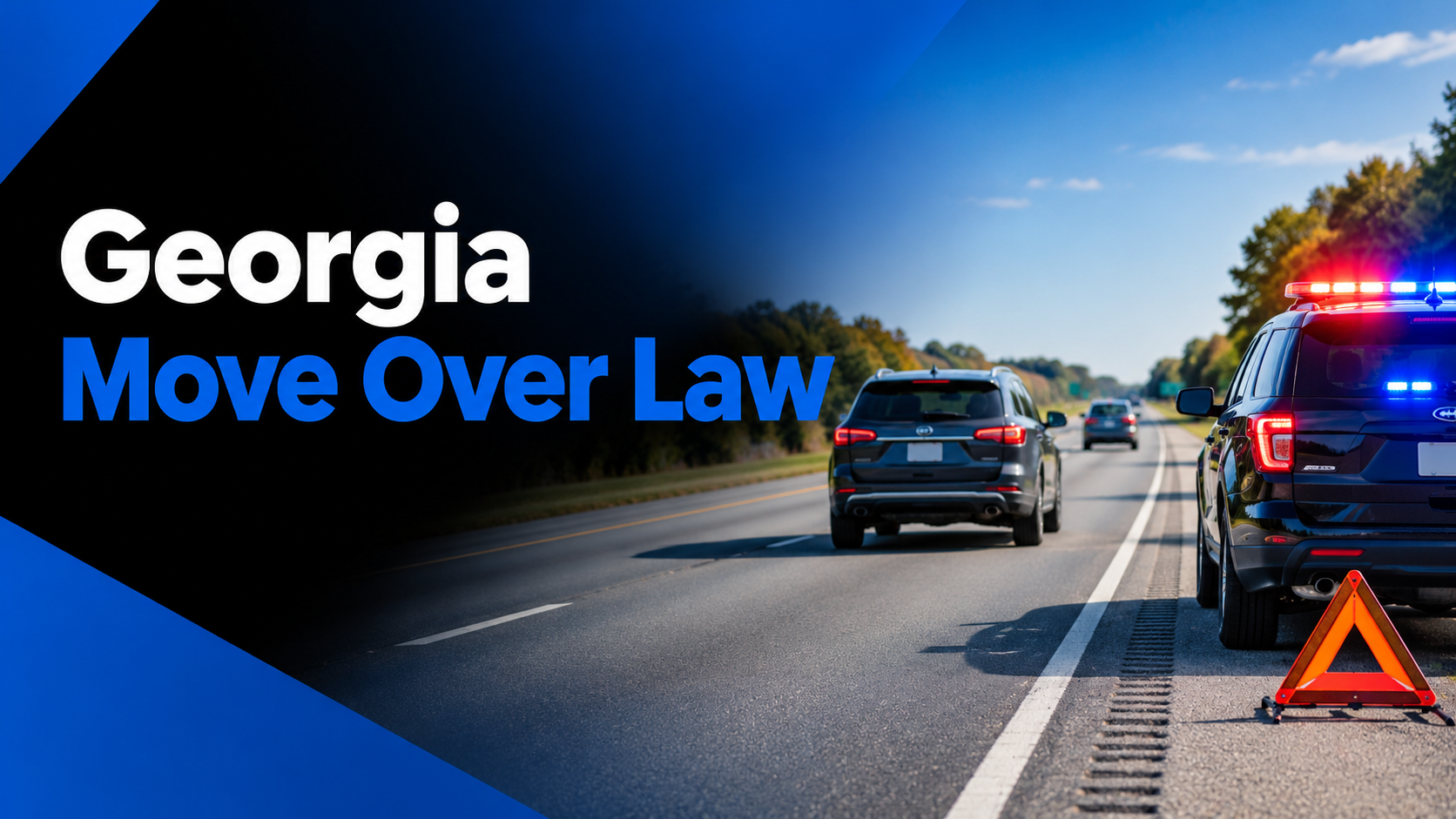
Imagine driving down I-75 or a local Georgia road when flashing lights appear on the shoulder. Do you know exactly what the law requires? Roadside workers and first responders face real danger every day from passing traffic. Georgia’s Move Over Law exists to create a safety buffer and save lives. This complete legal guide explains O.C.G.A. § 40-6-16 (also called the Spencer Pass Law), who it covers, the exact rules you must follow, fines and points, accident liability, and practical ways to defend a ticket. Whether you are a daily commuter, commercial driver, delivery professional, or someone who received a citation, understanding this law protects your license, wallet, and the people working on the roadside.
What Is the Georgia Move Over Law?
The Georgia Move Over Law is codified at O.C.G.A. § 40-6-16 and is officially known as the Spencer Pass Law. It requires drivers approaching certain stationary vehicles with flashing lights to either change lanes or slow down significantly.
The core rule is straightforward. When you approach a covered stationary vehicle displaying the required lights, you must:
- Make a lane change into a lane that is not adjacent to the vehicle, if it is possible given existing safety and traffic conditions, or
- If a lane change is impossible, prohibited by law, or unsafe, reduce your speed to a reasonable and proper speed that is less than the posted speed limit and be prepared to stop.
This applies on all Georgia roadways, not just interstates. The goal is simple: give roadside personnel a buffer zone so they can work without being struck by passing vehicles.
The law has been updated several times. It started in 2003. In 2011 the legislature named it after Spencer Pass, a Georgia Department of Transportation Highway Emergency Response Operator (HERO) killed while helping a motorist on I-85. Later expansions added utility service vehicles and clarified lighting requirements. A 2024 update refined the language around flashing or revolving lights for certain vehicles.
Which Vehicles Does the Move Over Law Cover?
Drivers often assume the rule applies only to police cars. It covers far more.
Authorized Emergency Vehicles
These include law enforcement vehicles, fire department apparatus, ambulances, and other authorized emergency vehicles displaying flashing yellow, amber, white, red, or blue lights. HERO units operated by the Georgia Department of Transportation fall under this protection when stationary with lights activated.
Towing, Recovery, Highway Maintenance, and Utility Vehicles
The law also applies to stationary towing or recovery vehicles, stationary highway maintenance vehicles (including many DOT trucks), and stationary utility service vehicles. These must either use traffic cones or display flashing or revolving yellow, amber, or white lights. Utility service vehicles cover workers providing electric, natural gas, water, wastewater, cable, telephone, or telecommunication services, plus related infrastructure work.
In short, if you see flashing lights (or cones on a utility or maintenance vehicle) on a stopped vehicle on the shoulder or roadside, treat it as covered. Tow trucks assisting at accident scenes, HERO units clearing incidents, and utility crews repairing lines all qualify in the appropriate circumstances.
Real-world example: You are in the right lane on a multi-lane highway and notice a tow truck with amber lights activated and cones placed. You must move left if traffic allows. If the left lane is packed, you slow below the speed limit and stay ready to stop.
Exact Driver Requirements Under O.C.G.A. § 40-6-16
The statute uses clear language. Approach with due caution. Absent direction from a peace officer, follow the two options above.
“Possible in the existing safety and traffic conditions” is key. Courts recognize that forcing a lane change into heavy traffic or across solid lines can create greater danger. The law does not require you to cause an accident. If moving over is unsafe or illegal, the slow-down option applies. Your reduced speed must be less than the posted limit and reasonable for conditions (weather, traffic density, road surface).
Barriers or medians matter. If a physical median separates your direction of travel from the stationary vehicle, the requirement typically does not apply in the same way. Always use caution.
Commercial drivers and delivery professionals face the same rules. A citation can affect a commercial driver’s license and employment, so compliance is especially important.
Fines, Points, and Other Penalties
Penalties differ slightly by vehicle type.
- Violation involving a stationary authorized emergency vehicle (subsection (b)): fine of not more than $500.
- Violation involving a stationary towing, recovery, highway maintenance, or utility service vehicle (subsection (c)): fine of not more than $250.
Court costs and surcharges usually increase the total amount paid. A conviction is a misdemeanor moving violation.
Georgia Department of Driver Services assesses 3 points on your license for a Move Over Law conviction under either subsection. Points remain relevant for two years. Accumulating 15 or more points in any consecutive 24-month period triggers a license suspension. Insurance companies often raise rates after points appear on a record, sometimes for several years.
If the violation contributes to an injury or death, civil liability and additional criminal exposure become possible. Paying the ticket admits guilt and places the points and conviction on your record. That decision has long-term consequences many drivers underestimate.
How to Defend a Georgia Move Over Law Ticket
You do not have to accept the citation at face value. Common defense approaches include:
Safety and impossibility. Argue that a lane change was unsafe or impossible due to traffic volume, weather, road conditions, or other vehicles. Evidence can include dashcam footage, weather reports, traffic density data, or witness statements. The statute itself provides this exception.
Lighting and vehicle status. The vehicle must have been stationary and displaying the required flashing or revolving lights (or using cones for certain categories). Question whether the lights were active and visible. Bodycam or dashcam from the citing officer can help or hurt this argument.
Officer observation and citation errors. Challenge whether the officer had a clear view of your actions and the surrounding conditions. Technical defects on the citation (wrong code section, inaccurate location, incomplete information) sometimes support dismissal.
Nolo contendere plea. In some courts a plea of nolo contendere (no contest) may be available once every five years. Under certain conditions it can avoid points assessment by DDS, though the conviction still appears on the court record. Availability depends on the judge and local practice.
Defensive driving or reduction. Some courts allow completion of an approved defensive driving course to reduce the fine or avoid points. Check local rules early.
Commercial drivers should treat these tickets seriously. A conviction can trigger employer reporting requirements and CDL consequences. Consulting a traffic defense attorney early often improves outcomes. An attorney can request discovery (video, reports), negotiate with the prosecutor, or prepare for trial.
Do not ignore the ticket or miss the court date. Failure to appear can lead to additional charges and license issues.
Move Over Law and Accident Liability
When a driver fails to move over or slow down and a collision occurs, the violation can support a negligence claim. Georgia follows a modified comparative negligence system. A plaintiff’s recovery is reduced by their percentage of fault, and recovery is barred if the plaintiff is 50 percent or more at fault.
In roadside collision cases involving emergency or service vehicles, the Move Over Law often becomes evidence of the standard of care. First responders, utility workers, or other drivers injured because someone failed to create a buffer may pursue personal injury claims. The citation itself does not automatically decide civil liability, but it is powerful evidence.
Accident victims should document the scene carefully, obtain the police report, identify witnesses, and seek medical evaluation promptly. Insurance companies scrutinize these cases closely. Speaking with a personal injury attorney familiar with Georgia traffic statutes helps evaluate comparative negligence issues and available recovery.
Practical Safety Tips for Georgia Drivers
Stay alert for flashing lights well ahead. Scan the shoulder and median regularly, especially on interstates and high-speed roads.
Signal early and move left when space exists. Give yourself room rather than waiting until the last second.
If you cannot change lanes safely, slow below the limit early and keep space. Be prepared for someone to step into the roadway or for a door to open.
Avoid distractions. Phone use and fatigue reduce reaction time exactly when you need it most.
Commercial and delivery drivers: build extra following distance and treat every set of flashing lights as a potential stop or slow-down zone.
These habits protect roadside workers and reduce your risk of a ticket or crash.
Common Pitfalls Drivers Face
Many tickets arise because drivers assume the law only covers police cars with blue lights. Tow trucks, HERO units, and utility vehicles with amber or white lights also trigger the duty.
Another frequent mistake is continuing at the posted speed in the adjacent lane simply because traffic is heavy. The statute still requires a speed reduction below the limit.
Some drivers move over too late or without checking mirrors and blind spots, creating new hazards. Plan the lane change early.
Ignoring the citation or paying it without understanding points and insurance impact is another costly error. Evaluate defense options first.
Conclusion
The Georgia Move Over Law exists to keep first responders, utility workers, tow operators, and HERO personnel safe while they work on or near our roadways. Knowing the exact requirements under O.C.G.A. § 40-6-16, the covered vehicles, the fines and three-point assessment, and available defense options helps you avoid costly mistakes. When in doubt, slow down early and create space if you can do so safely. If you have already received a citation or been involved in a roadside collision, evaluate your options promptly rather than simply paying the ticket. Consult a qualified Georgia traffic or personal injury attorney to review the facts of your situation and protect your driving record and legal rights.
FAQs
Do you have to move over for tow trucks in Georgia?
Yes, when a stationary towing or recovery vehicle displays the required flashing lights (or uses cones in applicable situations). The same move-over or slow-down rules apply.
How much is a Move Over Law ticket in Georgia?
Up to $500 for violations involving authorized emergency vehicles and up to $250 for towing, recovery, highway maintenance, or utility service vehicles, plus court costs.
How many points does a Move Over Law ticket put on your license?
Three points under the Georgia DDS points schedule for convictions under O.C.G.A. § 40-6-16(b) or (c).
Does the law apply on local roads or only highways?
It applies on all roadways in Georgia. The statute is not limited to interstates.
Can I fight a Move Over Law ticket successfully?
Yes. Defenses often focus on whether a lane change was safe or possible, whether the lights were properly displayed, and the accuracy of the officer’s observations. Video evidence and traffic conditions are frequently useful.
What if there is a median between me and the vehicle?
A physical median or barrier generally removes the requirement to move over for a vehicle on the opposite side, but always use caution and follow any officer directions.
Does the law cover HERO units and DOT vehicles?
Yes. HERO units and many DOT highway maintenance vehicles are covered when stationary with the appropriate lights activated.
You May Also Like: Understanding the Howard Morley Case: Mail Fraud & Corporate Liability


