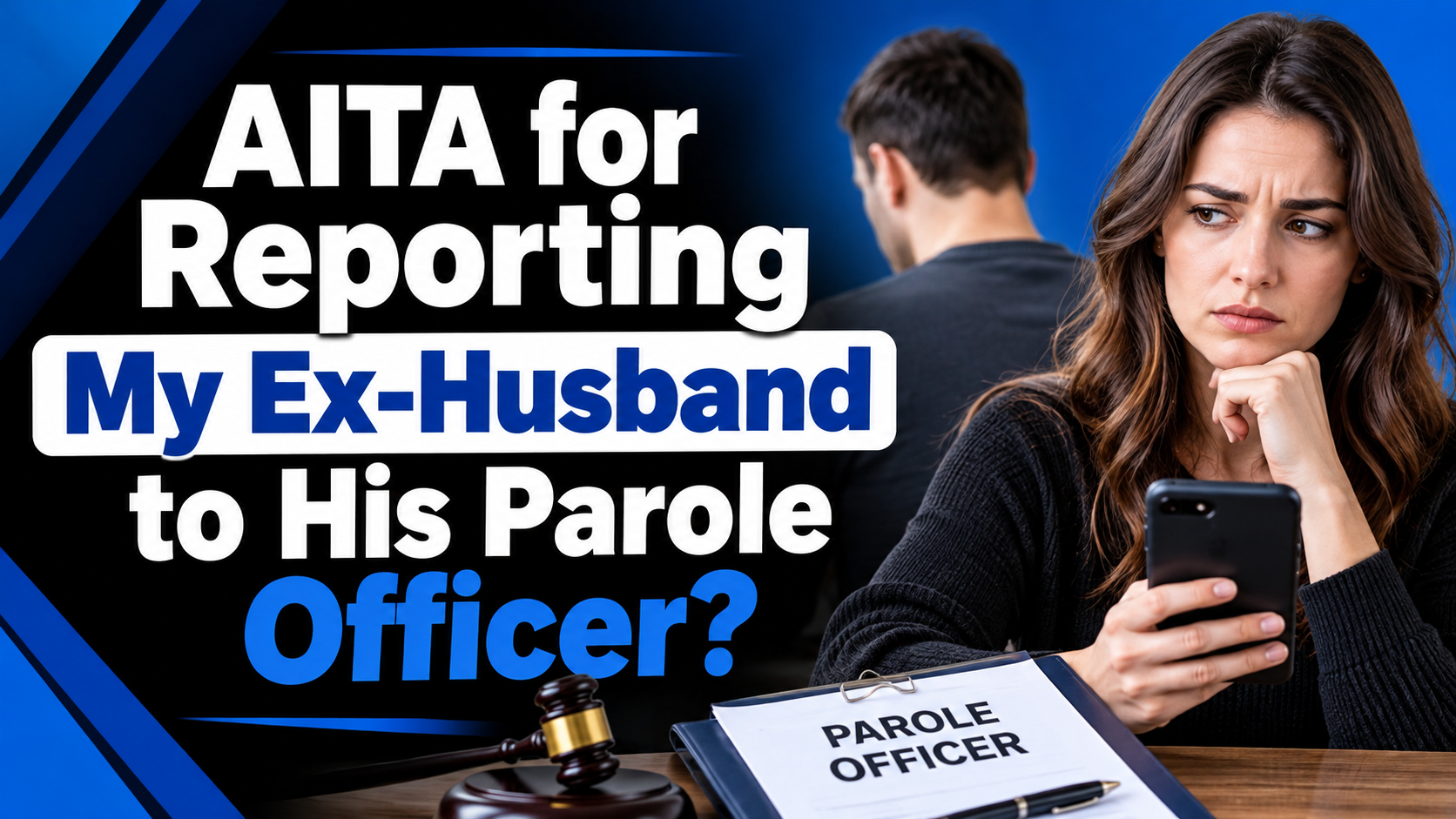
Imagine rebuilding your life after a marriage ends in betrayal and prison time, only for your past to walk up to your dinner table uninvited. That is the core of a viral Reddit story that has people debating personal safety, accountability, and the messy ethics of post-divorce boundaries. The poster, a woman who divorced her husband while he served time for credit card fraud, later reported him after he crossed state lines without permission and confronted her in public. The question “AITA for Reporting My Ex-Husband to His Parole Officer?” captures a tension many face when dealing with toxic exes, parole rules, and the fallout of deceit. This piece unpacks the ethical, legal, and emotional layers so readers can better navigate similar conflicts involving domestic boundaries, legal accountability, and post-divorce safety.
The Viral Reddit Story and Why It Resonates
The original poster described a five-year marriage that felt solid until her husband started bringing home unexplained money from supposed side contracting work. Police later charged him with multiple counts of credit card fraud. She learned he had lied for years. While he was incarcerated she filed for divorce, moved across the country, started a new job, and began a healthy relationship. Her ex was released early on good behavior after roughly four years.
Shortly afterward he appeared at a restaurant where she was dining with her boyfriend. He approached their table, claimed he just wanted to see her, and began arguing that she had been happier with him. She asked him to leave. He did. The encounter left her feeling deeply violated. After discussing it with her partner she contacted authorities. They indicated the unauthorized travel and contact would likely send him back to serve more time for a parole or probation violation. Old friends and his family then messaged her, calling her reaction excessive and accusing her of ruining his life. She admitted feeling guilty yet also relieved that contact could end.
The story spreads because it hits common pain points: a dishonest partner, the long shadow of incarceration, and the pressure to “just let it go” for the sake of peace or family harmony. Reddit commenters largely sided with the poster. Many noted that he chose to violate clear rules he understood. Others focused on the stalking-like quality of tracking someone across the country and interrupting a private moment. A smaller group questioned whether a single public confrontation justified returning him to custody, especially if no explicit no-contact order existed.
What makes the dilemma sharp is the mix of legal technicality and human emotion. Parole is not unconditional freedom. It is supervised release with conditions designed to protect the public and support reintegration. When those conditions are broken, reporting becomes one available response.
Understanding Parole and Probation Rules
Parole is early release from prison under supervision. Probation is a court-ordered alternative or addition to incarceration that also comes with conditions. Both typically include reporting requirements, restrictions on travel, employment expectations, and bans on new criminal activity or substance use. Travel rules are among the most common and strictly enforced.
Most jurisdictions limit a person on parole or probation to a specific county, judicial district, or state unless the supervising officer grants written permission in advance. Crossing those lines without approval is a classic technical violation. The purpose is straightforward: supervision only works if officers can locate the person, conduct home visits, and verify compliance. Unauthorized travel, especially across the country, undermines that system and can look like absconding.
When a violation is reported, the process usually starts with the parole or probation officer. The officer investigates, documents the claim, and may issue a warrant or hold a preliminary hearing. Evidence can include witness statements, location data, or police reports. A full revocation hearing follows in many cases. The standard of proof is generally a preponderance of the evidence, lower than the beyond-a-reasonable-doubt standard used at trial. Possible outcomes range from a warning or tighter conditions to full revocation and return to custody for some or all of the remaining sentence.
Reporting is not limited to law enforcement professionals. Private citizens can contact the supervising officer or local police and provide details of the alleged violation. Providing dates, locations, and a clear description helps. Documentation such as messages or eyewitness accounts strengthens the report. In the Reddit case, the public approach at a restaurant after long-distance travel supplied enough information for authorities to act.
These rules exist for public safety. Fraud convictions often involve patterns of deception. Early release on good behavior does not erase the underlying risk assessment that led to supervision conditions in the first place. Ignoring a clear violation can leave the system unable to respond until something more serious occurs.
The Ethical Debate: Safety Versus Second Chances
Is reporting the right move, or does it cross into unnecessary punishment? The ethical analysis starts with the poster’s legitimate interests. She had ended the marriage, relocated, and built a new life. An unannounced appearance by someone who previously deceived her for years carries an inherent threat to emotional and physical safety. Feeling violated is a reasonable response. Supporting a current partner’s preference for distance is also reasonable.
On the other side sits the argument for second chances. People leave prison hoping to rebuild. Family members often invest heavily in that hope and may view any report as vindictive. The poster herself felt residual guilt, a common reaction when the person who hurt you still triggers protective instincts or memories of better times. Guilt does not automatically mean the action was wrong. It often signals that someone retains empathy even after betrayal.
A balanced view recognizes that accountability and rehabilitation are not opposites. Parole conditions are part of the rehabilitation framework. Violating them by traveling far to confront an ex demonstrates poor impulse control and disregard for rules. Enabling that behavior by staying silent can undermine the very structure meant to help the person succeed. In toxic relationship dynamics, silence frequently allows patterns of boundary-testing to continue.
Real-world parallels appear often in advice communities. Someone learns an ex on supervision is contacting them despite restrictions, using substances, or associating with prohibited people. The consistent guidance from those with experience is that personal safety and legal compliance come first. Protecting your peace does not require hating the other person. It requires treating the rules as real.
Personal ethics here favor the reporter when the violation is clear, the contact feels invasive, and the reporter has already taken steps to separate. Waiting for a more dramatic incident is not a moral requirement. The poster did not invent the rules or force the travel. She responded to conduct that the system itself treats as serious.
Emotional Fallout and Managing Toxic Ex Dynamics
Divorce from someone who has been dishonest creates layered grief. The original betrayal of the fraud already eroded trust. The public confrontation reopened that wound in front of a new partner. Then came the secondary wave of judgment from mutual acquaintances. That combination explains the mix of relief and guilt the poster described.
Common emotional patterns in these situations include hypervigilance, second-guessing, and isolation. Hypervigilance makes sense after an unexpected appearance. Second-guessing often comes from external pressure or internalized messages that “good people” forgive and move on quietly. Isolation can grow when old social circles side with the person who broke the law.
Practical steps help. Document every interaction. Limit or eliminate direct communication. Lean on the current support system rather than people still invested in the former relationship. In some cases a formal protection order becomes appropriate if contact continues or escalates. Therapy focused on boundary work and trauma responses can reduce the lingering guilt. Many people discover that the guilt fades once the immediate threat of further contact decreases.
Toxic relationships after divorce often involve continued attempts at control or narrative-shaping. Family messages that frame the reporter as the problem are a form of that pressure. Recognizing the pattern helps. The person who chose to violate parole owns the consequences. The reporter owns the decision to prioritize safety.
Legal Accountability and Practical Considerations
Reporting a parole violation is generally protected speech when done in good faith to the proper authorities. False reports can create separate problems, so accuracy matters. Stick to observable facts: the person appeared at a specific place on a specific date after traveling from a restricted area, and the interaction included certain statements.
Consequences for the parolee depend on the jurisdiction, the nature of the original offense, prior compliance, and the seriousness of the new violation. Travel across the country without permission is rarely treated as minor. Courts and boards often view it as evidence that the person is not yet ready for unsupervised freedom.
For the reporter, practical protections include:
- Keeping records of the report and any subsequent communications.
- Updating personal security practices (privacy settings, awareness of shared contacts).
- Consulting local resources on restraining orders if contact resumes.
- Understanding that the parole system, not the reporter, decides the final sanction.
Readers dealing with similar issues should check their specific state rules. Conditions and procedures vary. Federal supervised release has its own framework under the U.S. Courts system. State parole boards set their own policies. Authoritative starting points include official state department of corrections sites and resources from the U.S. Courts on post-conviction supervision.
Broader Lessons for Post-Divorce Safety and Boundaries
This story illustrates several transferable points. First, early release does not erase the need for boundaries. Second, geographic distance is not always enough when someone is motivated to reconnect against the other person’s wishes. Third, social pressure from people who were not harmed by the original conduct often undervalues the impact on the person who was.
Healthy boundary-setting after a high-conflict or deceptive relationship usually requires clarity and consistency. Stating limits once is rarely sufficient if the other person tests them. Reporting a clear legal violation is one consistent response available when informal requests fail. It is not the only option, but it is a legitimate one.
People rebuilding after divorce from someone with a criminal history often benefit from treating safety as non-negotiable. That can mean legal tools, practical distance, and selective sharing of information. It also means resisting the narrative that the person who reports is the one creating drama. The drama began with the original crimes and continued with the boundary violation.
Conclusion
The viral question of whether someone is the asshole for reporting an ex-husband to his parole officer ultimately turns on facts most readers accept: the travel was unauthorized, the contact was unwelcome, and the reporter had already rebuilt her life. Legal systems treat such violations as serious for good reason. Ethical considerations around personal safety and accountability support the decision to report. Emotional complexity is real, yet guilt alone does not convert a reasonable protective act into wrongdoing.
If you face a similar situation involving a dishonest ex, parole conditions, or post-divorce safety concerns, document carefully, prioritize your well-being, and consult qualified professionals for advice tailored to your location. Understanding the rules and your options is the first step toward lasting peace.
FAQs
What usually happens after someone reports a parole violation?
The supervising officer investigates. If the claim holds up, the person may face a hearing that can result in tighter conditions, short jail time, or full revocation and return to custody.
Is unauthorized travel always a parole violation?
In nearly every jurisdiction, leaving the approved area without prior written permission is a standard condition violation. Cross-country travel is especially hard to justify without approval.
Can family pressure make reporting the wrong choice?
External opinions do not change the legal facts or the reporter’s right to safety. Family members often prioritize the parolee’s freedom over the other party’s boundaries.
Should I confront the person before reporting?
No legal requirement exists to do so. In cases involving potential risk or prior deceit, direct confrontation can escalate the situation. Reporting to authorities is a valid first step.
Does reporting guarantee the person goes back to prison?
Not always. Outcomes depend on the evidence, compliance history, and local practices. Even a warning or modified conditions can restore a measure of distance and accountability.
How can I protect myself after reporting?
Document everything, consider a protection order if contact continues, limit shared information, and seek support from trusted people or professionals experienced with post-separation safety.
Is it common to feel guilty after reporting?
Yes. Many people experience mixed emotions even when the action was justified. That feeling often decreases once the immediate threat of further unwanted contact lessens.
You May Also Like: Parole Cutoff Doesn’t Impact Overall Reoffending Rate: Prison Management Tips