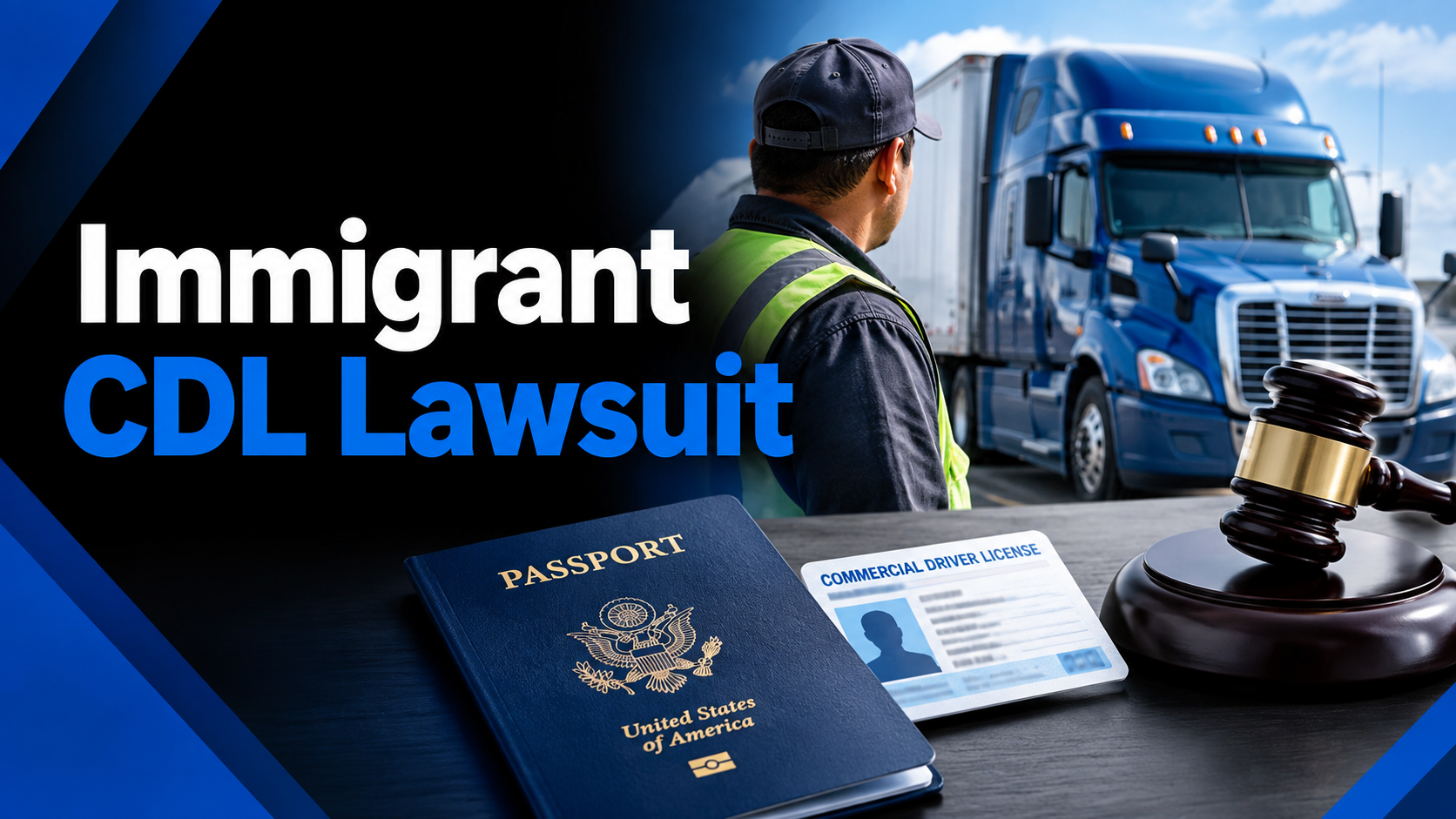
Roughly 200,000 non-domiciled commercial driver’s license holders face uncertainty as federal rules tighten eligibility and court challenges unfold. For many legal immigrant truckers, including DACA recipients and asylum seekers, a license that once secured steady work now hangs in the balance. Fleet owners and logistics managers watch closely, knowing any sharp drop in drivers could ripple through freight networks already strained by shortages.
This article examines the immigrant CDL lawsuit and related federal actions. It explains the FMCSA regulations, state compliance battles, federal highway fund withholdings, and what the disputes mean for drivers, carriers, and the broader supply chain. The goal is clear information so readers can assess risks and plan next steps.
What Is a Non-Domiciled CDL?
A non-domiciled CDL is a commercial driver’s license issued by a state to someone who is not permanently domiciled in that state. In practice, many holders are foreign nationals living and working in the United States who meet prior federal documentation standards.
Under older rules, states could issue these credentials when applicants showed proof of lawful presence, often through an Employment Authorization Document (EAD). The license let qualified drivers operate commercial motor vehicles across state lines. DACA recipients, refugees, asylum seekers, and certain other work-authorized immigrants commonly used this path.
The system relied on state driver’s licensing agencies (SDLAs) to verify documents and set expiration dates that matched the driver’s legal status. Audits later found widespread problems. Some states issued licenses that outlasted the underlying immigration documents. Others struggled to check foreign driving histories. FMCSA treated these gaps as safety risks.
The FMCSA Rule That Changed Everything
In September 2025, the Federal Motor Carrier Safety Administration published an interim final rule titled “Restoring Integrity to the Issuance of Non-Domiciled Commercial Drivers Licenses.” The rule sharply limited who could receive or renew a non-domiciled CLP or CDL.
Eligibility was restricted to individuals holding specific employment-based nonimmigrant statuses: H-2A (temporary agricultural workers), H-2B (temporary non-agricultural workers), and E-2 (treaty investors). Applicants had to present an unexpired foreign passport and Form I-94 or I-94A showing one of those statuses. States were required to query the Systematic Alien Verification for Entitlements (SAVE) system. Employment Authorization Documents alone were no longer sufficient.
FMCSA cited recent fatal crashes involving non-domiciled drivers and nationwide audit findings of regulatory non-compliance. The agency argued that state licensing offices could not reliably access foreign driving records, creating a vetting gap. Enhanced consular and interagency screening for the listed visa categories was presented as a workable proxy.
A D.C. Circuit administrative stay paused the interim rule in November 2025. FMCSA then issued a final rule, published in the Federal Register on February 13, 2026, and effective March 16, 2026. The final rule largely reaffirmed the interim restrictions with minor technical adjustments. Validity periods were capped at the earlier of the I-94 expiration or one year. In-person transactions became mandatory for issuance, renewal, transfer, and upgrade.
According to agency estimates, roughly 194,000 of the approximately 200,000 existing non-domiciled CDL holders would eventually become ineligible as licenses came up for renewal. Only about 6,000 new credentials per year were projected under the narrowed categories. Attrition was expected to unfold over roughly five years rather than all at once.
Official guidance appears on the FMCSA website, including detailed FAQs that clarify documentation, SAVE queries, and downgrade procedures. Readers can review the Federal Register notice and agency materials for primary sources.
The Immigrant CDL Lawsuit and Court Challenges
The central case is Rivera Lujan v. FMCSA, filed in the U.S. Court of Appeals for the D.C. Circuit. Lead petitioner Jorge Rivera Lujan is a DACA recipient who has lived in the United States since early childhood and held a commercial license for more than a decade. Co-petitioners include another driver and two large labor unions, AFSCME and the American Federation of Teachers.
Plaintiffs argue the rule violates the Administrative Procedure Act. They claim FMCSA lacked good cause to skip full notice-and-comment procedures on the interim rule, that the final rule remains arbitrary and capricious, and that the agency failed to show data linking the excluded immigration categories to higher crash rates. They note that many DACA recipients and long-term residents have extensive U.S. driving records that states can fully check. Excluding them, they say, rests more on immigration status than demonstrated safety risk.
An emergency stay of the interim rule was granted in late 2025. After the final rule took effect, the court denied a stay but expedited briefing. Oral argument occurred on September 15, 2026, before a three-judge panel. As of late September 2026, a decision remains pending. The rule stays in force while the case proceeds.
A separate lawsuit filed in April 2026 in the Southern District of Florida by nineteen non-domiciled drivers challenges both the federal rule and Florida’s implementation. Plaintiffs there describe lost jobs, financial distress, and deprivation of property and liberty interests without individualized safety findings.
California has also litigated related disputes over audits, pauses on new issuances, and funding. These cases highlight tensions between federal safety mandates and state licensing practices.
State Compliance Conflicts and Federal Funding Withholdings
FMCSA audits uncovered high rates of non-compliant non-domiciled credentials in multiple states. New York faced a final determination of substantial noncompliance after an audit found more than half of sampled records violated federal standards on lawful presence and expiration dates. The state declined to revoke thousands of licenses. In response, the Department of Transportation withheld approximately $73.5 million in federal highway funds.
California lost hundreds of millions amid similar findings and disputes over cooperation with audits and English-language requirements. Other states, including Pennsylvania, Minnesota, North Carolina, Texas, and others, received warnings or corrective action plans. Some paused new non-domiciled issuances until systems could meet the revised standards.
States that cannot verify status through SAVE or match license terms to immigration documents risk further funding cuts or even program decertification. This pressure has forced many SDLAs to audit existing credentials, revoke non-compliant ones, and tighten processes. For drivers, the practical result is that renewals now face stricter scrutiny, and some licenses issued under prior rules have been downgraded or canceled.
Real-World Impact on Drivers and Fleets
For individual drivers the stakes are immediate. A DACA recipient who has driven safely for years may discover at renewal that an EAD no longer qualifies. An asylum seeker with work authorization faces the same barrier. Loss of the CDL can mean lost employment, defaulted loans, and difficulty supporting a family. Plaintiffs in the Florida case described exactly these consequences.
Fleet owners and logistics managers confront capacity and compliance risks. Carriers that relied on non-domiciled drivers must audit qualification files, track immigration documents, and plan for attrition. Even if existing licenses remain valid until expiration, renewals will fail for most current holders. Mid-size and smaller fleets that leaned more heavily on this segment feel the pressure first.
Industry analysts project a staggered reduction of tens of thousands of drivers per year. Some carriers report upward pressure on wages as the pool shrinks. Shippers may eventually see tighter capacity and higher rates, especially in regions or lanes that depended on these drivers. At the same time, organizations such as the Owner-Operator Independent Drivers Association have supported the tighter rules as a long-overdue safety measure.
The broader freight supply chain impact remains uncertain. Trucking already operates with high turnover and chronic shortages. Removing a meaningful share of experienced drivers could amplify those pressures, yet FMCSA maintains that excess capacity and normal hiring cycles will absorb the change over time.
Legal Presence Compliance and Documentation Requirements
Under the final rule, “evidence of lawful immigration status” is narrowly defined. For non-domiciled applicants it means an unexpired foreign passport plus an I-94/I-94A reflecting H-2A, H-2B, or E-2 status. SAVE verification is mandatory. States must not issue credentials that outlast the Admit Until Date or one year, whichever comes first.
Drivers and carriers should maintain current copies of all immigration documents in the driver qualification file. Any change in status that removes eligibility requires prompt notification so the state can initiate a downgrade within required timelines. Operating after a license becomes invalid exposes both driver and motor carrier to enforcement action and civil liability.
What Comes Next?
The D.C. Circuit decision in Rivera Lujan will shape the near-term landscape. Possible outcomes range from upholding the rule, to vacating it, to remanding for further explanation or narrower restrictions. Separate state funding disputes and the Florida litigation add additional layers of uncertainty.
In the meantime the March 2026 final rule governs. States continue audits and corrective actions. Drivers whose licenses expire face the new eligibility tests. Fleets that have not yet reviewed their non-domiciled driver population should do so promptly.
Key Takeaways for Stakeholders
- Non-domiciled CDL eligibility is now limited to specific visa categories.
- Most current holders relying on EADs or other statuses will become ineligible at renewal.
- Federal funding pressure has forced many states to tighten or pause issuance.
- Court challenges, especially Rivera Lujan v. FMCSA, remain active with a decision pending after September 2026 oral argument.
- Drivers should confirm their documentation status early. Carriers should audit files and plan for attrition.
Frequently Asked Questions
Can DACA recipients hold a commercial driver’s license under current rules?
Under the final rule effective March 16, 2026, DACA status alone does not qualify an individual for a non-domiciled CDL. Eligibility is limited to H-2A, H-2B, and E-2 visa holders who present the required passport and I-94 documentation.
How does the immigrant CDL lawsuit impact trucking fleets?
If the rule is upheld, fleets face gradual loss of roughly 194,000 drivers over several years as licenses expire. This can tighten capacity, raise labor costs, and require closer monitoring of immigration documents in qualification files.
What happens if a state refuses to comply with FMCSA non-domiciled CDL rules?
FMCSA can withhold a percentage of federal highway funds and, in severe cases, move toward decertification of the state’s CDL program. New York and California have already experienced multimillion-dollar withholdings.
Are existing non-domiciled CDLs automatically canceled?
The final rule does not require immediate mass cancellation of properly issued prior licenses. However, states are strongly encouraged to revoke non-compliant credentials, and many have done so after audits. Renewal under the old standards is no longer permitted.
What documents are required for a non-domiciled CDL now?
An unexpired foreign passport and Form I-94 or I-94A showing H-2A, H-2B, or E-2 status, verified through SAVE. Employment Authorization Documents by themselves are insufficient.
Could federal court rulings restore broader eligibility?
Yes. A decision vacating or narrowing the rule could reopen pathways for DACA recipients, asylum seekers, and others previously eligible via EAD. Until then the March 2026 standards control.
How should carriers protect themselves during this period?
Audit all non-domiciled driver files, track expiration and immigration status dates, document compliance steps, and prepare contingency hiring plans. Consult transportation counsel familiar with both FMCSA and immigration requirements.
You May Also Like: Navy Federal Class Action Settlement: Claim Deadlines, Eligibility, and Payouts




One Comment on “Immigrant CDL Lawsuit: Non-Domiciled Licenses at Risk”