Filing court papers on your own can feel overwhelming. One wrong form or missing signature and your case stalls before it starts. Many self-filers mix up two key documents that look similar but serve different jobs: the verified petition and the affidavit. Getting this difference right protects your rights and keeps your case moving.
This guide breaks down the verified petition vs affidavit in plain language. You will see when each document is required, how courts treat them, and the practical steps that help pro se litigants, family law clients, and property owners avoid common pitfalls. No jargon without clear explanations. Just clear, useful information so you can file with confidence.
What Is a Verified Petition?
A petition is the formal paper that starts many civil cases, especially special proceedings. Think of it as your request to the court for a specific legal remedy. You state the facts, identify the parties, explain your cause of action, and ask the court for relief such as a divorce decree, custody order, or review of a government decision.
A verified petition adds one critical piece: a sworn statement (the verification) that the facts in the petition are true. The person signing, usually the petitioner, declares under penalty of perjury that the allegations are accurate to the best of their knowledge. This turns ordinary allegations into sworn statements that courts often treat with greater weight.
In many states, family courts require verified petitions for divorce, legal separation, or parenting plans. Special proceedings, such as challenges to agency decisions, also commonly demand verification. The verification clause sits at the end of the petition and must follow the exact language your court rules require.
Why Verification Matters
Without verification, a petition is simply an unverified pleading. Courts still accept it in ordinary lawsuits, but many rules demand a sworn version when the court needs reliable facts early in the case. A verified petition can support requests for temporary orders because the facts already carry the force of a sworn statement.
Courts treat a properly verified petition as the functional equivalent of an affidavit in many situations. That means the facts you swore to can serve as evidentiary support at the start of the case, before any live testimony occurs.
What Is an Affidavit?
An affidavit is a standalone written statement of facts made under oath or under penalty of perjury. The person making the statement (the affiant) signs it, and in traditional form a notary public administers the oath and stamps the document. Modern rules in federal court and many states also allow an unsworn declaration under 28 U.S.C. § 1746 that carries the same weight without a notary.
Unlike a petition, an affidavit does not start a case or request relief. Its sole job is to present facts the court can rely on as evidence. You attach affidavits to motions, use them to support or oppose summary judgment, or file them with applications for temporary restraining orders.
The statements in an affidavit must rest on personal knowledge whenever possible. If you rely on information and belief, you should say so and identify the source. False statements expose the affiant to the same perjury penalties that apply to courtroom testimony.
Common Uses of Affidavits
Self-filers and legal assistants often prepare affidavits for:
- Supporting a motion for temporary custody or support
- Proving service of process
- Establishing income or expenses in family cases
- Authenticating documents in property disputes
- Providing facts for emergency relief
An affidavit stands alone. Courts can accept it even if no petition or complaint exists yet.
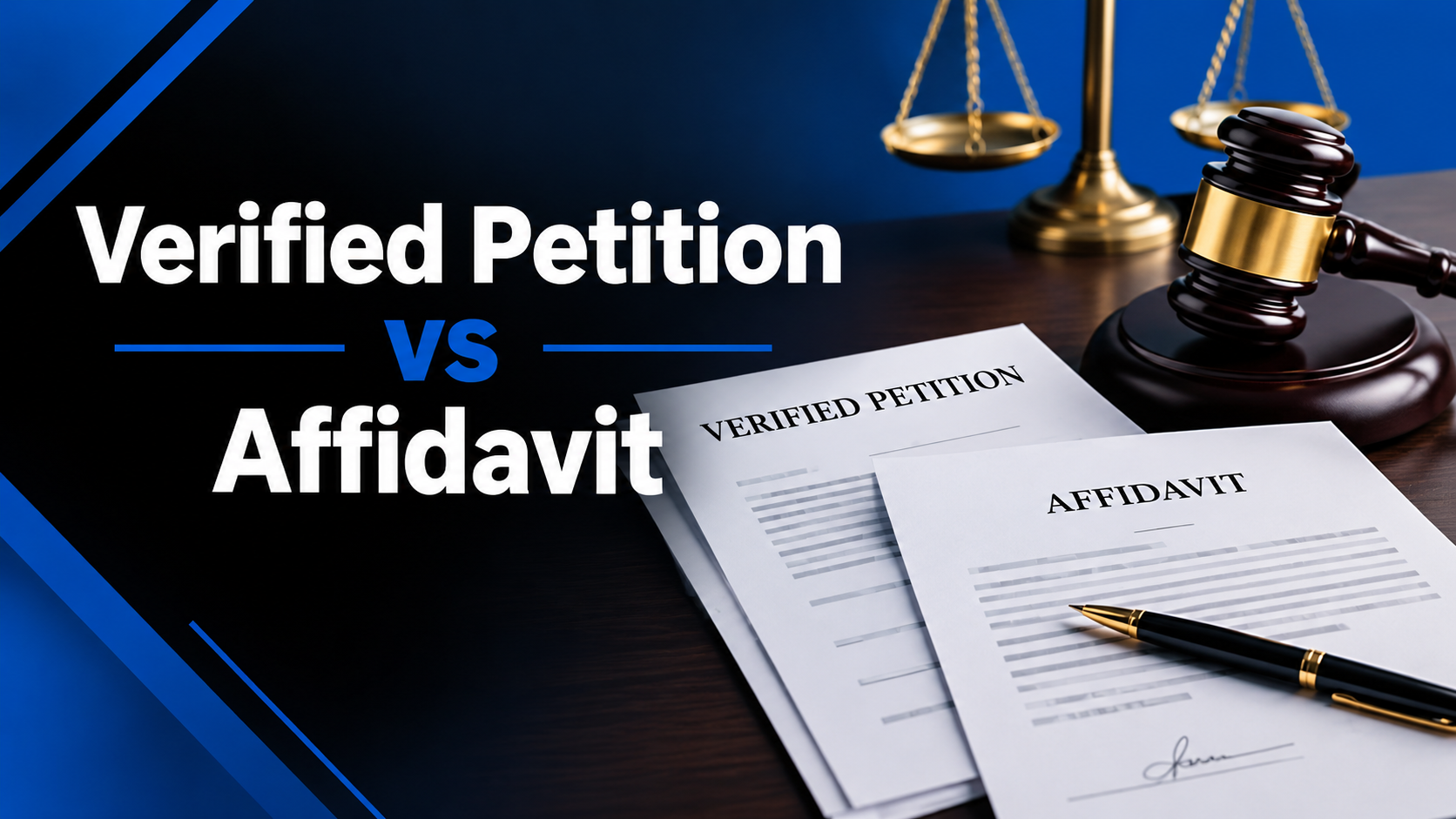
Verified Petition vs Affidavit: The Core Differences
The verified petition vs affidavit distinction comes down to purpose, structure, and role in the case.
A verified petition is a pleading. It frames the legal dispute, states the cause of action, and asks for legal remedies. The verification simply swears that the facts inside that pleading are true. The document remains the vehicle that starts the proceeding.
An affidavit is pure evidentiary support. It does not request anything from the court. It supplies facts the court may use to decide motions or early applications.
Here is a practical comparison:
- Function: Petition starts the case and seeks relief. Affidavit supports claims with sworn facts.
- Structure: Petition contains numbered allegations, a prayer for relief, and a verification clause at the end. Affidavit contains numbered factual paragraphs and a jurat or declaration at the end.
- When required: Rules often mandate verified petitions in family law and special proceedings. Affidavits appear whenever a party needs to prove facts outside the pleadings.
- Evidentiary weight: Both can serve as evidence. A verified petition often functions like an affidavit under rules such as New York CPLR 105(u). A standalone affidavit is always designed for that purpose.
- Who signs: The party usually verifies a petition. Anyone with knowledge can sign an affidavit, though the strongest ones come from people with direct personal knowledge.
Can an affidavit replace a verified petition? Rarely. Courts generally require the petition itself to be verified when the rules demand it. An accompanying affidavit may help, but it does not cure the missing verification on the pleading. Some courts have accepted papers that function as the equivalent of a verified petition when the combined documents give clear notice of the claims and relief sought, yet that approach is the exception, not the rule.
When to Use a Verified Petition vs Affidavit
Choosing the right document depends on the stage of the case and the relief you seek.
Family Law and Divorce Proceedings
In divorce, legal separation, or custody cases, most states require a verified petition (sometimes called a verified complaint). You file the verified petition to open the case. Later, when you need temporary support or a protective order, you often attach one or more affidavits that supply current facts about income, expenses, or safety concerns.
A verified petition vs affidavit in divorce proceedings works together: the petition frames the long-term requests, while affidavits give the court fresh, sworn details for immediate decisions.
Property Matters and Civil Disputes
Quiet title actions, partition suits, and some landlord-tenant cases may require verified pleadings. Supporting affidavits then prove ownership, payment history, or the condition of the property. An affidavit alone cannot start most of these actions.
Emergency Relief and Injunctions
When you need a temporary restraining order or preliminary injunction, courts demand sworn facts. Many rules accept either a verified petition or a separate affidavit (or both). The verified petition can itself supply the necessary sworn foundation if the facts appear in it and the verification is proper.
Special Proceedings
Challenges to government decisions, election contests, and certain probate matters often begin with a verified petition. Supporting affidavits expand on the factual record.
Always check your local court rules or the statute that governs your specific cause of action. Requirements vary by state and even by county.
How Verification Works: The Clause and Formalities
The verification clause is short but powerful. A typical version reads something like this:
“I, [Name], am the petitioner in this action. I have read the foregoing petition and know its contents. The matters stated are true of my own knowledge, except as to those matters stated on information and belief, and as to those matters I believe them to be true. I declare under penalty of perjury that the foregoing is true and correct. Executed on [date].”
Federal practice and many states allow this language without a notary under 28 U.S.C. § 1746. Other jurisdictions still require a traditional affidavit-style verification signed before a notary public.
Step-by-Step: Preparing a Verified Petition
- Draft the petition with clear, numbered paragraphs that state the facts and the relief you seek.
- Review every factual allegation. Qualify anything you know only secondhand with “on information and belief.”
- Add the verification clause at the end, using the exact language your court prefers.
- Sign and date the verification. If a notary is required, sign in the notary’s presence.
- File the complete document with the court clerk and serve the other parties according to the rules.
Step-by-Step: Preparing an Affidavit
- Title the document clearly (for example, “Affidavit of [Name] in Support of Motion for Temporary Support”).
- State your full name, address, and relationship to the case in the opening paragraph.
- Set out the facts in numbered paragraphs, sticking to personal knowledge.
- Attach any exhibits and refer to them in the text.
- End with the declaration or jurat language and sign.
- Have the document notarized if local rules require it, or use the unsworn declaration form if allowed.
Legal Weight and Perjury Risks
Both documents carry serious consequences. A false statement in a verified petition or an affidavit can lead to perjury penalties, including fines and possible jail time. Courts may also impose sanctions, strike the pleading, or dismiss the case.
Because a verified petition is treated as evidence in many jurisdictions, the facts you swear to can be used against you later if they prove inaccurate. That is why careful review before signing is essential. Never verify allegations you cannot support.
Unique insight from practice: many self-filers treat verification as a formality. Seasoned attorneys treat it as the moment the case becomes real. One paralegal shared that a client once verified a petition containing a date error that later undercut a key claim. The court accepted the verified statement as true, and the client had to live with the inconsistency. Double-checking every fact before you sign is the single best protection you have.
Common Filing Mistakes Self-Filers Make
Even careful people trip over the same problems:
- Filing an unverified petition when the rules require verification
- Using the wrong verification language for the jurisdiction
- Signing a verification without reading the entire document
- Attaching an affidavit but forgetting to verify the petition itself
- Relying solely on information and belief without identifying sources
- Missing the notary requirement in states that still demand it
- Treating a supporting affidavit as a substitute for a required verified petition
Avoid these by reading the local rules, using court-provided forms when available, and having a trusted person review the papers before filing. Court self-help centers and many legal aid websites offer free checklists for court filing requirements.
For deeper guidance on related steps, see our internal resource on how to file a divorce petition and our overview of preparing supporting affidavits for family court. External readers can also consult the federal unsworn declaration statute at 28 U.S.C. § 1746 and state court self-help pages such as those maintained by the California Courts or New York Courts.
Practical Scenarios
Imagine you are seeking temporary custody. You file a verified petition for custody that opens the case and states the basic facts under oath. You then prepare a detailed affidavit describing recent incidents, school records, and your work schedule. The verified petition starts the proceeding; the affidavit supplies the fresh evidence the judge needs for the temporary order hearing.
In a property boundary dispute, the verified petition or complaint lays out the ownership claim and the requested quiet-title relief. An affidavit from a surveyor or longtime neighbor then provides the factual foundation the court needs to evaluate the claim early.
These examples show how the two documents work side by side rather than as rivals.
Conclusion
The verified petition vs affidavit distinction is straightforward once you focus on purpose. A verified petition is the sworn pleading that starts many cases and requests relief. An affidavit is the standalone sworn statement that supplies evidence. Both carry the weight of an oath and both expose the signer to perjury penalties if the facts prove false.
Use a verified petition when the rules require it to open the case. Use affidavits whenever you need to prove specific facts in support of motions or applications. Check local court filing requirements, use precise verification language, and review every statement before you sign.
This information is educational only and is not formal legal advice. Court rules change and every case is unique. Consult a qualified attorney or your local self-help center to evaluate your specific situation and confirm the exact forms and language your court demands.
Frequently Asked Questions
What is the main difference between a verified petition and an affidavit?
A verified petition is a pleading that starts a case and includes a sworn verification of its facts. An affidavit is a separate sworn statement used purely as evidence.
Is a verified petition considered evidence?
Yes, in many jurisdictions a properly verified petition is treated as the equivalent of an affidavit and can supply evidentiary support for early motions and temporary orders.
Can an affidavit replace a verified petition?
Generally no. When rules require a verified petition, an accompanying affidavit does not usually cure the lack of verification on the petition itself.
Do I always need a notary public for these documents?
Not always. Federal law and many states accept unsworn declarations under penalty of perjury. Some states and specific proceedings still require a traditional notarized form.
When is a verified petition required in divorce proceedings?
Most family courts require the initial petition for divorce or custody to be verified. Check your state’s family code or local rules for the exact requirement.
What happens if I make a false statement in a verified petition or affidavit?
You risk perjury charges, court sanctions, and damage to your credibility. Always limit statements to facts you know or clearly mark as information and belief.
Where can I find a sample verification clause?
Court self-help websites and official forms often include the preferred language. A common federal-style declaration appears under 28 U.S.C. § 1746.
You May Also Like: Do Affidavits Need to Be Notarized? The Complete Guide