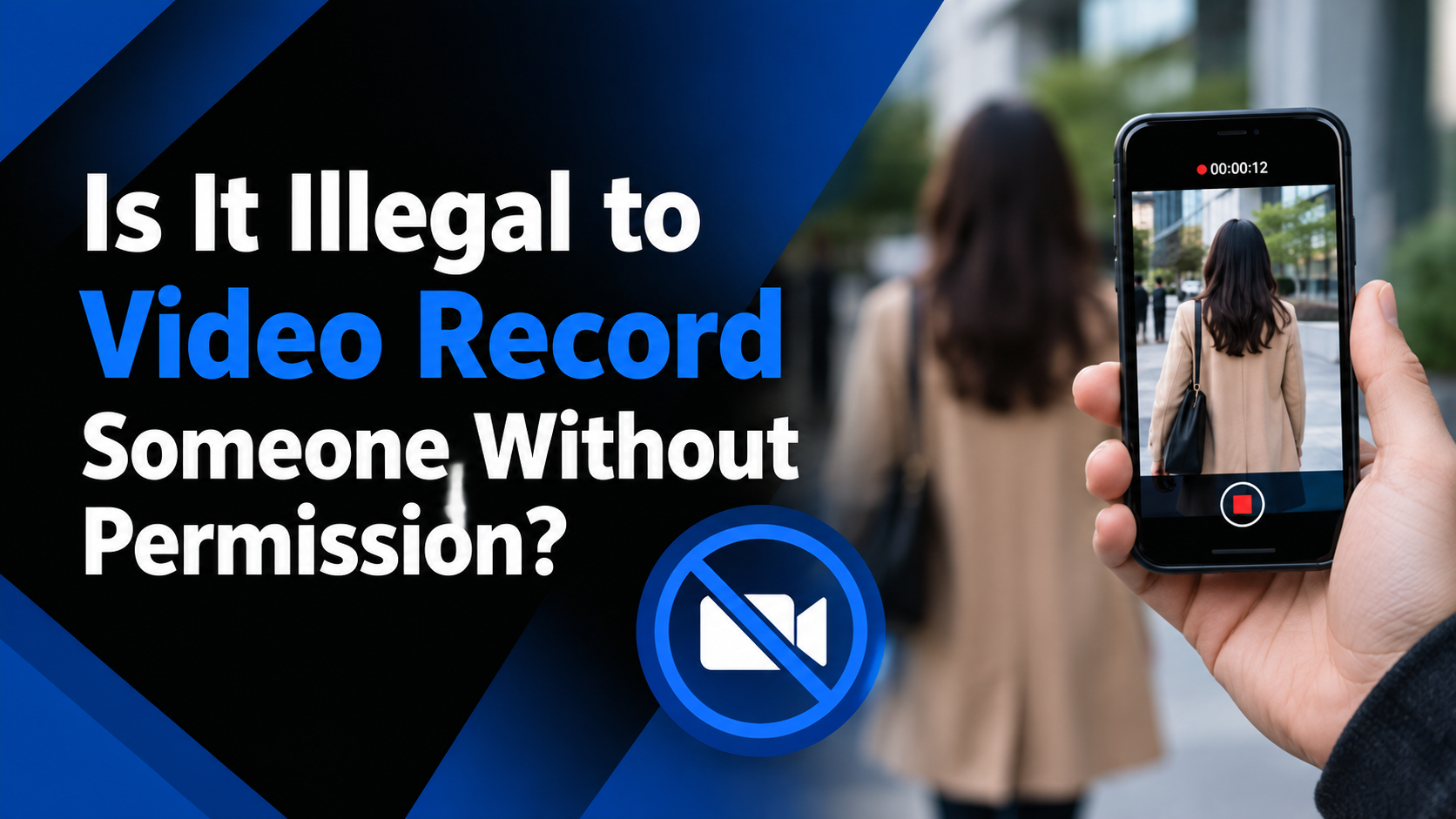
Pull out your phone in a crowded park, on a busy sidewalk, or at a protest, and you might wonder: is it illegal to video record someone without their permission? Millions of people capture everyday moments this way every day. Yet the line between protected recording and a potential legal problem is not always obvious.
This guide breaks down U.S. video recording privacy laws in plain language. You will learn how the reasonable expectation of privacy shapes what is allowed, why audio rules differ from pure video, and how state consent laws, the First Amendment, and federal statutes like the Video Voyeurism Act come into play. Whether you are a content creator, journalist, employer, employee, or everyday citizen, the goal is practical clarity so you can stay compliant while protecting your rights.
The Core Rule: Reasonable Expectation of Privacy
Courts decide most recording disputes with one central test drawn from the Supreme Court’s decision in Katz v. United States. A person must have an actual (subjective) expectation of privacy, and society must recognize that expectation as reasonable (objective).
What you knowingly expose to the public receives little protection. Walking down a street, sitting on a park bench, or speaking at normal volume in an open plaza means others can see and hear you. Silent video recording of those activities is generally legal across the United States. You do not need the person’s permission simply because they appear in the frame.
Private spaces flip the analysis. Inside a home, hotel room, bathroom stall, locker room, or changing area, the expectation of privacy is high. Recording without consent in those locations can lead to civil claims for invasion of privacy or criminal charges under state voyeurism statutes and, in some cases, federal law.
Semi-public places create gray areas. A shopping mall, restaurant, or office lobby is often private property open to the public. The property owner can set rules and ask you to stop filming or leave. Refusal after a lawful request can support a trespass charge even if the recording itself would have been fine from a public sidewalk.
Filming in Public Spaces: What the Law Allows
In traditional public forums (streets, sidewalks, parks, plazas, and similar open areas) the First Amendment strongly protects the right to record what is in plain view. Federal appellate courts have repeatedly recognized this right for ordinary citizens as well as journalists. The protection is especially clear when the recording involves government officials performing their duties in public.
You can film a street performer, a protest march, police interacting with the public, or ordinary people going about their day. No consent is required for the visual portion. Courts treat a camera the same way they treat the human eye: if the activity is visible from a lawful public vantage point, capturing it on video is generally allowed.
Limits still exist. Using technology to defeat privacy measures (a telephoto lens aimed through a closed bedroom window from the sidewalk, or a drone hovering over a fenced backyard) can cross into illegal territory. Persistent following that rises to harassment or stalking is also prohibited even if each individual recording would have been legal on its own.
Recording Police and Public Officials
Multiple federal circuit courts have held that the First Amendment protects the right to record law enforcement officers and other government officials carrying out official duties in public. You may film from a safe distance that does not interfere with the officers’ work. Officers generally cannot seize your phone without a warrant or order you to delete footage simply because you are recording.
Practical safety tips remain important. Stay calm, keep a reasonable distance, and do not physically obstruct anyone. If an officer orders you to stop recording, you may politely assert your rights, but de-escalate if the situation becomes heated. Document the interaction carefully afterward.
Video Versus Audio: Why the Difference Matters
Here is the distinction that trips up most people. Wiretapping and eavesdropping statutes primarily target the interception of oral communications. Silent video usually falls outside those laws. The moment your recording captures audio of a conversation, state and federal consent rules apply.
Federal law under 18 U.S.C. § 2511 follows a one-party consent standard. If you are a participant in the conversation, or if at least one participant consents, the recording is generally lawful under federal rules. Most states mirror this approach.
A smaller group of states require all-party (sometimes called two-party) consent. In those jurisdictions every participant must agree before the conversation can be recorded. Lists of all-party states have included California, Connecticut, Delaware, Florida, Illinois, Maryland, Massachusetts, Montana, New Hampshire, Pennsylvania, and Washington, though exact classifications can shift with legislation and court rulings. Always verify the current rule in your location.
Because smartphones record video and audio together by default, many everyday recordings accidentally capture sound. In an all-party consent state, that audio component can turn an otherwise legal public video into an illegal recording if the speakers had a reasonable expectation that their words were private.
Practical tip: when in doubt, mute the audio or obtain clear consent before relying on the sound track.
Private Property and Workplace Considerations
On private property the owner’s rules control access. A store, restaurant, or office can post signs prohibiting filming and enforce those rules by asking you to leave. Continuing to record after a lawful request may support trespass liability.
Employers often install security cameras in common areas such as lobbies, hallways, and parking lots. Those cameras are generally lawful when they do not invade areas of high privacy expectation (restrooms, changing rooms, or private offices). Audio recording on workplace cameras must still comply with the applicable one-party or all-party consent rules.
Employees who want to record conversations at work face the same consent framework. In a one-party consent state an employee who participates in the discussion can usually record it. In an all-party state every participant must consent. Company policies may impose additional restrictions even when the recording itself is legal under state law.
Recording a coworker or customer in a private office or restroom without consent is almost always unlawful. The same is true for hidden cameras placed in bedrooms or bathrooms of a private home.
Federal Protections: The Video Voyeurism Act
Even in public places, federal law draws a firm line against certain recordings. The Video Voyeurism Prevention Act (18 U.S.C. § 1801) makes it a crime to intentionally capture an image of a person’s private area (naked or undergarment-clad genitals, pubic area, buttocks, or female breast) without consent under circumstances in which the person has a reasonable expectation of privacy.
Importantly, the statute applies “regardless of whether that person is in a public or private place.” Angling a camera under clothing on a public sidewalk can therefore violate federal law. The offense is a misdemeanor punishable by up to one year in prison and a fine. Most states have parallel voyeurism statutes that often carry stronger penalties.
This law does not prohibit lawful law-enforcement, correctional, or intelligence activity.
Commercial Use, Publication, and Admissibility
Recording someone in public for personal use is usually fine. Using the footage commercially (advertising, stock footage, or monetized social media) raises additional considerations. Many content creators blur faces or obtain releases when individuals are identifiable and the use is commercial. News reporting and commentary generally receive stronger First Amendment protection.
Whether a recording is admissible in court depends on how it was obtained and the rules of the specific jurisdiction. Illegally obtained audio may be excluded under wiretap statutes. Purely visual public recordings that respect privacy expectations are more likely to be admitted, subject to the usual rules of relevance and authenticity.
Penalties and Civil Liability
Criminal penalties for illegal recording vary widely. Violations of state wiretap or eavesdropping laws can range from misdemeanors to felonies carrying prison time and substantial fines. Voyeurism offenses often trigger both criminal charges and civil lawsuits.
Civil claims may include invasion of privacy, intentional infliction of emotional distress, or statutory damages under state recording statutes. Federal law also allows civil recovery for certain unlawful interceptions. Damages can include actual harm, statutory minimums, punitive awards, and attorney fees.
Harassment, stalking, or defamation claims can arise even when the initial recording was lawful if the subsequent use or pattern of behavior crosses legal lines.
Practical Compliance Tips for Everyday Recording
- Prefer public spaces where the activity is in plain view.
- Mute audio or obtain clear consent when conversations are involved, especially in all-party consent states.
- Respect posted “no filming” rules on private property and leave when asked.
- Avoid any recording that captures private body areas without consent.
- Keep a reasonable distance from police or other officials and do not interfere.
- When publishing, consider whether faces should be blurred for non-newsworthy commercial uses.
- Document the circumstances of any important recording (date, time, location, and your lawful presence).
These steps do not create absolute immunity, but they dramatically reduce legal risk.
Common Real-World Scenarios
Filming a street argument: Usually legal for video. Audio may require consent depending on the state and whether the speakers had a privacy expectation.
Security camera on a front porch: Lawful for video of public-facing areas. Audio must follow consent rules.
Recording a coworker in an open office: Video is often fine; audio depends on consent laws and company policy.
Hidden camera in a bathroom: Illegal under voyeurism statutes almost everywhere.
Dashcam footage of an accident: Generally admissible and lawful when the camera captures what is visible from a public roadway.
Conclusion
Is it illegal to video record someone without their permission? In most public settings the answer is no, provided you respect the reasonable expectation of privacy and handle any audio component carefully. The First Amendment protects recording of public events and officials, while state consent laws and federal voyeurism statutes set important boundaries.
Know your state’s rules, distinguish pure video from audio, and avoid areas of high privacy expectation. When the situation is complex or high-stakes, consult a qualified attorney licensed in your jurisdiction for advice tailored to the facts. Staying informed lets you exercise your rights while respecting the rights of others.
Frequently Asked Questions
Is it illegal to video record someone without their permission on private property?
Yes, if the person has a reasonable expectation of privacy or the property owner has prohibited recording and you refuse to leave. Publicly visible areas of private property viewed from a lawful public vantage point are usually different.
Can you video record someone in public without their consent?
Generally yes for silent video of activities in plain view. Audio is governed by separate consent laws that vary by state.
Is video recording without permission admissible in court?
It depends on how the recording was obtained, whether it violates wiretap or privacy statutes, and the specific evidentiary rules of the court. Lawful public video is more likely to be admitted than secretly recorded private conversations.
Is it illegal to film someone at work without consent?
It depends on the location within the workplace, whether audio is captured, and applicable state consent laws. Common areas are usually less restricted than private offices or restrooms. Employer policies may add further limits.
What are the penalties for recording someone on video without permission?
Penalties range from civil damages and misdemeanor fines to felony prison time, depending on the statute violated (voyeurism, wiretapping, harassment) and the jurisdiction.
Do two-party consent states apply to pure video?
Usually not. Those statutes primarily regulate the interception of oral communications. Once audio is included, the consent rules apply.
Does the First Amendment protect my right to record in public?
Yes. Multiple federal courts have recognized a First Amendment right to record matters of public interest, including police activity, in traditional public forums.
You May Also Like: Who Is Robert Alessi? Trial Attorney Profile & Legal Impact